Divorce

This is a touchy subject for many, many people. These days, about half of couples get divorced, which is just insane to me! That means that most people have been touched by divorce in some way, whether their parents divorced, they are divorced themselves, or they know someone who has been divorced. I’m not sure anything shows Satan’s attack on the family quite as well as the increasing prevalence of divorce. Families everywhere are shattering into pieces, along with the hearts of children and spouses.

My dad’s parents got divorced when he, the oldest child, was 14. My parents got divorced when I, the oldest child, was 14. A pattern was beginning, and that scared me. Therefore, I decided I was NEVER getting married. I was just so afraid of my marriage ending that I thought I could avoid it altogether. I was terrified of inflicting the pain I had felt when my parents divorced upon my own children, so I made the decision that I just wouldn’t have kids altogether. I think this is a common reaction among children of divorced parents, and so I want to direct my message to those lovely, broken people who have given up hope. I’m so sorry for what happened to you, but I promise, YOU DON’T HAVE TO REPEAT THE MISTAKES OF YOUR PARENTS. You have this wonderful opportunity ahead of you to create the life for your children that you didn’t get to have.

I think the first step in this process of accepting your parent’s divorce while leaving the door open for your own marriage is acknowledging the pain you went through. I think it is pretty much impossible to watch two people you love decide they don’t love each other, and not have some lasting negative effects in your life. I can remember feeling completely alone. I couldn’t turn to my parents, because they were grappling with their own demons and their own pain. I couldn’t turn to my friends, because they all had what seemed to be perfect little families. It was just me and my siblings, surrounded by a storm of anger and change and loss.

Okay, you say, I get it. I’m messed up. I already knew that, Jenna. So why don’t you tell me something I don’t know?

Here’s something you probably don’t know. Or at least, it is something I still wrestle with. Why did my parents get divorced? Of course, I know the overarching reasons. I know about the fights and the mistakes and the betrayals. But, I still don’t totally understand. I don’t understand why my parents got divorced while other people in similar situations end up staying together. That doesn’t seem totally fair to me.

That confusion, which I think most of us deal with, brings me to the next step- understanding the patterns of dysfunction that led to your parent’s divorce. In my case, as I have learned more about both of my parents and their struggles, I have realized that the situation wasn’t as black and white as I once imagined. There wasn’t one person to blame. Rather, it was a combination of factors and mistakes that led up to their divorce.

I know this is painful, but take some time to reflect on your parents and their marriage. If you were too young when they were divorced, ask others who were present at the time. Ask yourself “What patterns of dysfunction led to their divorce?” As much as this process just straight up stinks, it will help you learn about the unhealthy patterns that existed in the home you were raised in. Once you have labeled those cycles, you can work through any tendencies you have to repeat the mistakes of your parents. For example, I have adopted my dad’s habit of bottling up emotions instead of talking them through. I am trying to express my emotions and become more open in preparation for my own marriage.

The third step is realizing that most problems in marriage can be overcome without separation. President James E. Faust said that the only time divorce should be considered is in “a prolonged and apparently irredeemable relationship which is destructive to a person’s dignity as a human being”. The book offers several suggestions to ensure that the decision to divorce is the correct one.

  • Allow time to decide about the divorce: Although it may be tempting to bow out at the first sign of trouble, a marriage is something worth fighting for. Remember, this is someone you once love SO much that you promised to spend forever with them. Don’t give up on forever too quickly.
  • Try to resolve problems first: If both people are willing to change, then there is hope! Marriage counseling is a great option. A trained professional can offer suggestions and help that can totally change your relationship. For example, if you are struggling to communicate effectively then a therapist can offer suggestions that can alleviate the problem.
  • Make adjustments to your expectations: Perhaps your spouse is no longer interested in going to church with you, or is struggling with an addiction. Rather than washing your hands of the entire relationship, consider the possibility of putting aside your needs for a time and helping them through. Pray to know how to support them while staying mentally healthy yourself. In addition, look for things you need to change in order to be a better spouse.

Here’s the thing. Regardless of whether you follow these steps or not, marriage is a risk. It’s a huge risk. You are giving your heart to an imperfect human being who will, undoubtedly, make mistakes. However, it is SO worth it. Marriage means having a constant companion during the best and worst times of your life. It means having someone to raise children with. It means love and joy and passion and friendship. So take the leap.

Trials in Family Life

Perhaps my greatest fear about creating a family is the loss that comes with love. Death, illness, or separation of any kind is painful. In families, all of us will face trials and tribulations. Maybe it comes in the form of infertility. Maybe it comes in the form of a special needs child. Maybe it comes when a spouse decides they no longer want to be married. However, all of this risk is ultimately SO worth it. I’d like to take a few moments to talk about why, and how, this is the case.

First, these moments in the refiner’s fire help us become what God wants us to become. For example, when a special needs child comes into the world, this gives their parents an opportunity to become more like Christ. The unconditional, self-sacrificing love they feel for their child is a semblance of the love Heavenly Father feels for each of us. No other experience could bring about such a change of heart.

However, this opportunity for growth is just that, an opportunity. We must choose how we will react to the challenges in our lives. My tendency when trials come is to ask “Why me?” I get frustrated with God for testing me beyond what I feel I can handle. I am learning that the best thing I can do is submit to God’s will. Every time I do that, life ends up working out in ways I could never imagined. I am working on developing an eternal perspective so that I can see trials as small, short events that can prepare me for God’s presence.

Can you think about moments in your life where you have been placed directly into the refiner’s fire? How did that experience change you? Would you be the same person you are today without that event?

Secondly, our families can help support us through trials. An illness in one family member, for example, is a trial that can be shared among all family members. If the mother has cancer, the children can carry more responsibilities at home. The father can provide emotional and financial support throughout surgeries and treatments. When grief or sorrow comes, family members can rely on each other and bear up their burdens. We don’t have to go it alone!

Thirdly, without the difficult times of life, we wouldn’t be able to experience the great joys in life. According to Elder Bruce C. Hafen, “Somehow, our joyful experiences mean more when we are fully conscious of the alternatives and the contrasts that surround us. We prize the sweet more when we have tasted the bitter. We appreciate our health when we see sickness. . . . These contrasts do not deter our idealism. Properly understood, they only make the moments of the true joy worth waiting for.”

Now that we understand the necessity of trials, let’s discuss one of the most difficult trials of this life: death. Up to this point, the only people I have lost are my great-grandparents. I realize this is unusual as a 20-year-old, and I am aware that someday soon I will have to face the loss of someone I love. I am TERRIFIED of that day.

As a member of the Church of Jesus Christ of Latter Day Saints, I know that death is only temporary. I know that someday, I will see my family again. However, although that knowledge is powerful and comforting, grief is still a normal part of human existence. Just look at this picture of a grieving President Hinckley at his wife’s funeral.

Image result for president hinckley at wife's funeral

Despite his knowledge about God’s plan, he still felt incredible pain after losing his wife. Grief, in my eyes, is love. It shows that you care so deeply for someone that their loss causes indescribable sadness.

In fact, I just read the story of Lazarus in the Bible, and several parts of the story impacted me in a way they hadn’t before. When Lazarus died, his sisters were distraught. When Jesus saw Mary crying, He began to cry as well. In fact, the scriptures say “he groaned in the spirit, and was troubled” (John 11:33). As I read this, I wondered why Jesus would cry. He knew what was coming; He knew Lazarus would rise again. Yet, He still wept. Then, I realized that Jesus wasn’t crying for Lazarus. He was crying because He felt empathy for Mary and Martha’s pain.

I know that Christ weeps when we weep, even though He knows that our loved one is in a better place. He now has perfect empathy because He has actually felt our pain. When He atoned for our sins, He also atoned for our pains, our losses, our tears. When we grieve, I hope we can envision Christ weeping with and for us. We are never alone. We have our families, and we have Christ.

Forgiving the Unforgivable

I’d like to dedicate this post to those of us who are struggling to forgive someone in our family. This topic is very important to me because I have a personal connection to the subject. In the life of someone very close to me, I have seen how refusing to forgive has robbed her of happiness. To start, I’d like to share a little bit of that story, without betraying any confidences by sharing her name. For our purposes, let’s call her “Melinda”.

Melinda was married in the temple to someone she believed was a worthy priesthood holder. She had three children with him, and was married for fifteen years. However, twelve years into their marriage, she discovered that her husband had a pornography addiction that he had hid since the beginning of their marriage. She was understandably hurt and betrayed, but she wanted to make things work. For three years, she tried to help him through the recovery process, but eventually things reached a breaking point. She filed for divorce.

I wish that was the end of the sad part of the story, but it isn’t. Melinda’s pain turned into a deep, seething anger. For years, she harbored resentment towards her ex-husband, and towards anyone who loved him. After a while, that anger even began to affect her physical health and mobility. As someone who loves Melinda, this was incredibly painful to watch. Her anger changed her to the point that she was no longer the woman I remembered.

I think most of us can understand why Melinda was hurt by her husband’s actions. Those feelings were valid. However, somewhere along the way, things went really wrong. To understand why, and to better grasp the concepts of forgiveness and repentance, let’s break this story down a little bit by looking at it alongside the factors associated with forgiveness.

  1. Situational factors: These include how much harm was intended, how often the offense was repeated, what the consequences of that offense was, whether those consequences were remedied, and whether the offender apologized. In Melinda’s case, the offense was repeated very often and had drastic consequences that couldn’t be remedied by the person who hurt her.
  2. Relational factors: These include who the offender was, their relationship with the person they hurt, their attitude, and the environment. In Melinda’s case, she was hurt by the person she was supposed to trust most in the world: her husband.
  3. Personality factors: This means how inclined the victim is to forgive based on their personality. For example, Melinda had a ruminating personality that made it hard for her to forgive even the slightest offenses.

As one can clearly see, there was a perfect storm of factors that made forgiveness difficult. Yet, the purpose of this post is to show you that forgiveness and repentance are always possible, regardless of the circumstances. These virtues have the ability to bring peace in situations where peace may seem impossible.

In many cases, forgiveness comes after an apology that acknowledges the offense, expresses regret, offers restitution, and promises not to repeat the offense. In addition, in an affective apology, the offender also repents of their sin by recognizing their wrongdoing, feeling sorrow due to their sin, forsaking the sin, confessing it, and righting the wrong. But that’s the ideal situation, right? How many times does someone do something truly awful without following the repentance OR the apology steps??

How do we forgive in those situations? How do we develop empathy for someone who is unwilling to empathize with us? How do we release our anger without any restitution or remorse on the part of our offender?

According to Successful Marriages and Families, there are five steps to follow when forgiving someone.

  1. We acknowledge and remember the pain we felt. In Melinda’s situation, that would mean revisiting a very painful time in her life. This is an uncomfortable, but essential, starting point.
  2. Empathize with the offender. For instance, Melinda would have to acknowledge the pain from her husband’s childhood that contributed to his unhealthy coping mechanisms. She would have to feel pain for him and all that he lost as a result of his choices.
  3. Share the offense with someone we trust. Although it might be hard to open up, this helps the victim (like Melinda) break through feelings of confusion or shame.
  4. Create boundaries to protect themselves from future harm. For example, just because Melinda forgives her ex doesn’t mean she should spend a bunch of time with him.
  5. Lastly, we find ways to achieve restitution, even if that doesn’t involve the offender. For example, Melinda might begin a new hobby or start a new job. Essentially, she should look for ways to fill her life with joy.

As we choose to forgive loved ones who may have wronged us, our burden will be lifted. We will have the opportunity to find joy in new life experiences. As I learned about this subject this week, I realized that there are members of my family who I need to forgive in order to be a happier, better person. I hope that all of us can begin the forgiveness process. I’m going to sign off, but before I do, here is a short video with a woman who exemplifies forgiveness in her family.

Praying as a Family

Last year, a boy broke my heart. At first, it was really tempting to harbor a grudge towards him. A few weeks later (after copious amounts of ice cream and peanut butter) I was at church and a girl started talking about her experience praying for someone who had hurt her. I realized that I needed to pray for the boy who had hurt me in order to move on and let go of my lingering resentment. That night, I knelt down and prayed for him. I prayed that he would find joy, and that I would be able to see him through my Heavenly Father’s eyes. After that prayer, I felt more peace than I had felt in weeks. As I continued to pray for him (because if I am being honest, those feelings of anger took a while to go away), it felt as if my heart was stitched back together.

Due to my experience, I am super excited to talk with you all about prayer and family life. Since then, I have used prayer to forgive family members who I believe have wronged me, and also as a way to help family members who are in need. I have seen firsthand the miracles that prayer can bring about. Hence, I’d like to list some of the ways prayer can help families.

Something from the reading this week that really hit me was the idea that prayer can sanctify a family. Sanctification means making something sacred, so this means that prayer can take the family to a holier plain by inviting the Spirit into the home and the relationship. I have seen that in the relationships of those I love. For example, my dad and step-mom pray for each of their children (step or not) by name each night. This has strengthened their bond with each other AND with us kids. They are also more unified as they parent together.

Prayer can protect the family from the influences that might tear it apart. Alma 37:37 says “Counsel with the Lord in all thy doings, and he will direct thee for good.” As he “directs us for good”, he can help us avoid temptations that destroy the family, like pornography or infidelity.

Prayer can heal wounds from contention and anger. Just as I was able to forgive after praying, couples can better love the other person when they pray for each other. In addition, as they pray together and come before God as a couple, they can grow closer to God and to each other.

Family prayer helps children develop a personal relationship with God. For example, as I participated in family prayer as a child each day, I could see God answering our prayers. At one point, I remember praying for an extended family member who was ill and had to have surgery. He healed from the surgery, and I remember thinking that God had answered our prayer. Even as a young child, I could understand the purpose of prayer. As I grew older, I learned to apply that gift in my own life.

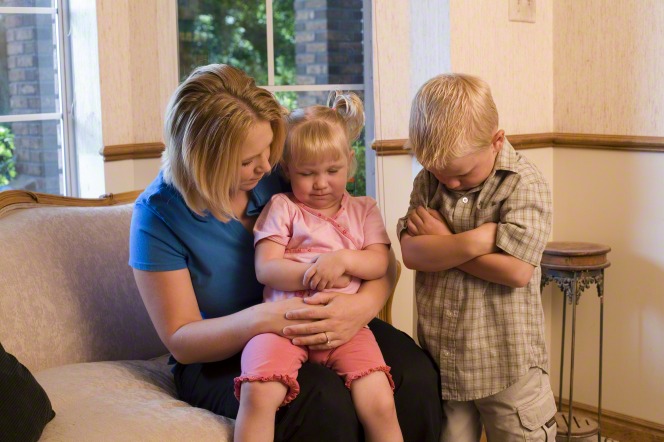
A mother sits on a couch with her daughter in her lap and her son next to her while all three pray.

Prayer can help families endure through hard trials. At this point in my life, I don’t think I would survive without prayer. I am SO grateful that my parents taught me about the importance of approaching God in faith and humility because prayer has gotten me through the most difficult times. Sometimes, the prayers that have meant the most aren’t the prayers I have offered. They are the prayers that my mom, or grandma, or dad, have offered in my behalf. For instance, when I broke my hip, I felt buoyed up by the faith of my family.

If you have not prayed for a long time, need direction or peace, or simply want to know if God is really there, I challenge you to kneel and pray. He is there. He loves you. He loves each member of your family. He is aware of everything you are facing. I promise that He will help you if you only ask.